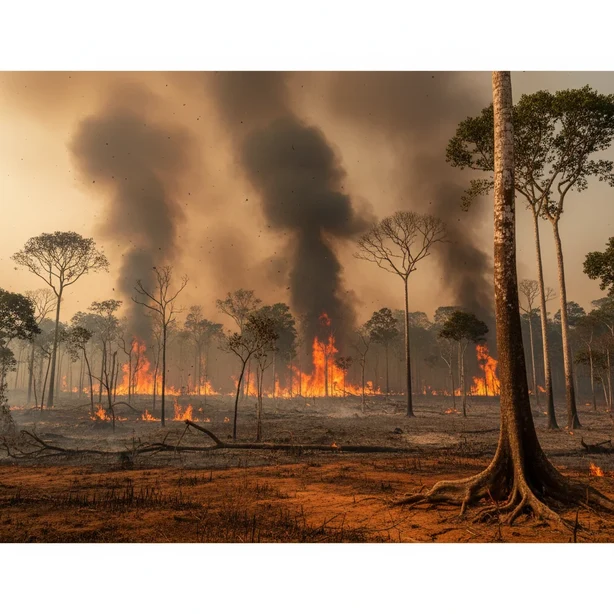
In 2024, the Amazon rainforest experienced its most devastating wildfire season in more than two decades, driven by extreme climate events and increased human activity — despite a general slowdown in deforestation rates.
A new study by the Joint Research Centre of the European Commission revealed that wildfires destroyed around 3.3 million hectares of rainforest (approximately 33,000 square kilometers) in a single year. Researchers said the fires caused record levels of carbon emissions and widespread ecological degradation, exposing the region’s “growing environmental fragility.”
Using data from tropical forest monitoring systems and advanced techniques to filter out false signals caused by agricultural fires or cloud cover, scientists were able to detect the impact of wildfires with unprecedented accuracy.
According to the findings, the 2024 fires released about 791 million tons of carbon dioxide into the atmosphere — roughly equivalent to Germany’s annual emissions. This represents a sevenfold increase compared to the average of the previous two years, marking the first time that fire-induced forest degradation has surpassed deforestation as the main driver of carbon emissions in the Amazon.
The study warned that the growing number of wildfires — fueled by climate change and unsustainable land use — could push the Amazon toward a catastrophic ecological tipping point. Researchers also expressed concern about the wide geographic spread of the fires: Brazil recorded its highest-ever emissions from forest degradation, while Bolivia lost about 9% of its remaining intact forest cover, a dramatic blow to one of the world’s key biodiversity and carbon storage regions.
Historically, the Amazon’s high humidity and regular rainfall made it naturally resistant to wildfires, but the severe droughts and heatwaves of 2023 and 2024 drastically reduced surface water and soil moisture, increasing both the likelihood and intensity of fires.
Researchers linked this unprecedented surge in fire activity to extreme drought conditions, worsened by climate change and forest fragmentation — the breaking up of large, continuous forests into smaller patches due to human expansion and poor land management. This includes so-called “escape fires,” deliberately set by firefighters to create firebreaks against larger blazes, as well as fires started to clear land for cattle ranching, soybean cultivation, palm oil production, and other agricultural uses.
The report emphasized that fires do not always result in full deforestation but can gradually degrade forests, noting that “degraded forests may appear healthy from above but have lost much of their biomass and ecological function.”
Researchers called for urgent and coordinated action to limit the use of fire in land management, strengthen forest protection policies, and support local and Indigenous communities in sustainable forest management.
Government data from Brazil showed that in 2024, the Amazon recorded its highest number of fires in 17 years, with over 140,000 wildfires detected by satellites after months of prolonged drought.
Known as the “lungs of the planet,” the Amazon rainforest is home to about 400 billion trees, absorbs nearly 1.5 gigatons of carbon dioxide annually, and spans around 5 million square kilometers across nine South American countries — with about 60% of its area in Brazil.
However, deforestation, rising temperatures, and both natural and man-made fires have turned parts of the Amazon from a carbon sink into a carbon source, worsening the global climate crisis.