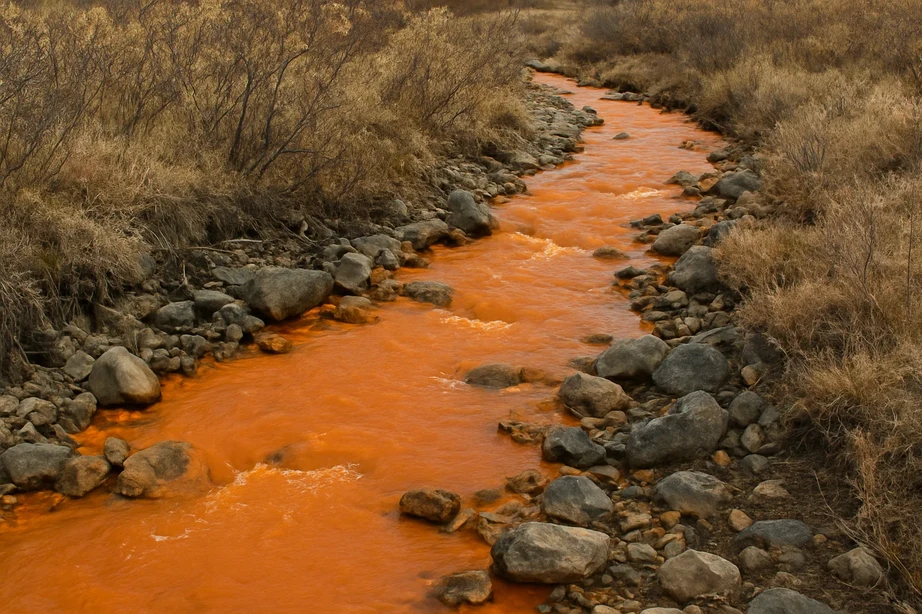
In the remote Brooks Range of northern Alaska, rivers that were once clear and pristine are now turning a rusty orange, a striking sign of the impacts of global warming. The thawing of long-frozen permafrost has triggered a chain of chemical reactions that not only change the color of the waters but also threaten entire ecosystems, from fish to birds and larger wildlife.
For thousands of years, this frozen soil acted as a natural vault, trapping minerals beneath the surface. But as rising temperatures allow water and oxygen to seep in, sulfide-rich rocks begin to break down. This process releases sulfuric acid, which dissolves minerals such as iron, cadmium, and aluminum, flushing them into streams and rivers and staining the waters orange.
“This looks like acid mine drainage,” said Tim Lyons, a biogeochemist at the University of California, “but here there is no mine. The only cause is melting permafrost.”
A recent study published in the Proceedings of the National Academy of Sciences confirms that what is happening to Alaska’s Salmon River is not an isolated case. Dozens of other waterways across the Arctic are showing similar signs, raising alarms about the scale of the threat. David Cooper, a researcher at Colorado State University who has worked in the Brooks Range since 1976, described the recent shifts in terrain and water chemistry as “astonishing and deeply concerning.”
According to the study, thawing permafrost triggers geochemical reactions that oxidize sulfide-rich rocks like pyrite. This increases acidity and mobilizes a wide range of metals. Some, such as cadmium, accumulate in fish tissues and then move up the food chain to predators like bears and birds. Meanwhile, iron-saturated waters block light from reaching the riverbed, suffocating insect larvae that salmon and other fish depend on for food.
Although current levels of metals in edible fish remain within safe limits for humans, scientists warn that if these processes continue, pollutants could accumulate to dangerous levels. The larger risk lies in the indirect but severe impacts on ecosystems, where disruptions at the base of the food chain ripple through to higher species.
Lyons stresses that this phenomenon is not just about one river. “It’s happening across the Arctic. Wherever there are the right rocks and thawing permafrost, this process can begin.” Unlike at mining sites, where acid drainage can be mitigated with barriers or containment systems, these remote landscapes contain hundreds of diffuse pollution sources with no infrastructure to manage them.
Researchers warn that once these reactions begin, they are nearly impossible to reverse. Only the refreezing of permafrost could halt them, a scenario increasingly unlikely in a warming world. Lyons calls it “another irreversible transformation driven by climate change.”
Scott Zolkos, an Arctic climate scientist at the Woodwell Climate Research Center in the UK, notes that the region is warming at least two to three times faster than the rest of the planet. This means these changes are not only ongoing but will likely intensify in the decades ahead.
Alaska’s orange rivers thus reveal a new face of climate change—a reminder that even the most remote and untouched corners of the Earth are no longer safe from its reach, and that the transformations underway in the Arctic may carry lasting consequences far beyond the region itself.