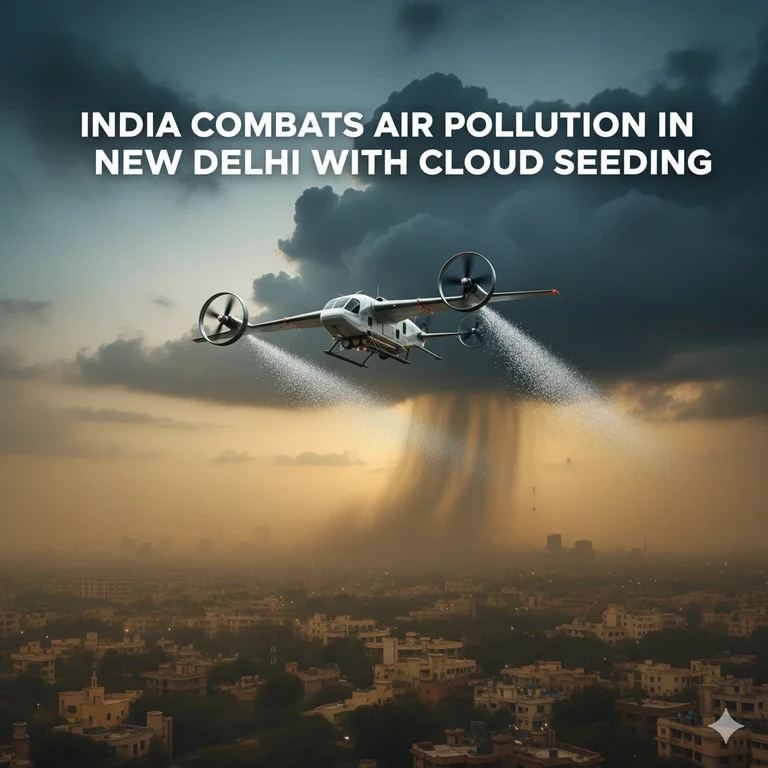
For the first time, India has carried out artificial rainfall over New Delhi by cloud seeding using an aircraft in an effort to disperse the toxic smog that has blanketed the capital for days.
The operation took place on Thursday through cooperation between New Delhi authorities and the Indian Institute of Technology in Kanpur, using a small Cessna aircraft over the Burari area north of the capital. Environment Minister Manjinder Singh Sirsa said in a statement that the flight was experimental, involving the launch of rockets to seed clouds, though the type of chemical used was not disclosed.
Sirsa explained that the purpose of the test was to evaluate Delhi’s cloud-seeding capabilities, ensure the readiness of the aircraft and equipment, test the efficiency of the rockets, and improve coordination among all involved agencies.
Meanwhile, Prime Minister Richa Gupta stated that New Delhi could witness its first artificial rainfall on October 29 if weather conditions remain favorable.
With a population exceeding 30 million, New Delhi is among the most polluted cities in the world, alongside other Indian metropolises such as Kolkata and Mumbai. During winter, layers of cold air become trapped under warmer air, creating a “lid” that prevents pollutants from factories, traffic, and crop burning from dispersing into higher altitudes.
On some days, concentrations of fine particulate matter (PM2.5)—tiny particles that can enter the bloodstream—exceed the World Health Organization’s safe limit by more than 60 times.
Earlier this week, air quality in New Delhi deteriorated to hazardous levels, recording the highest pollution readings in the world, according to Swiss group IQAir. Experts attribute this spike partly to fireworks during the Hindu Festival of Lights (Diwali).
The Air Quality Index (AQI) measures the concentration of five main pollutants: ground-level ozone, particulate matter, carbon monoxide, nitrogen dioxide, and sulfur dioxide. Developed by the U.S. Environmental Protection Agency, the scale ranges from 0 (very clean air) to 500 (extremely polluted air).
Studies indicate that air pollution kills around 7 million people each year worldwide. Even if the use of fossil fuels—a major cause of pollution—is reduced, the benefits for climate change will take decades or even centuries to appear, since greenhouse gases remain in the atmosphere for long periods.