In a monumental astronomical achievement, an international team of scientists has compiled the largest catalog of galaxy clusters ever, using data from the Dark Energy Survey. This ambitious project provides a three-dimensional “growth fingerprint” of the universe from the Big Bang to the present day.
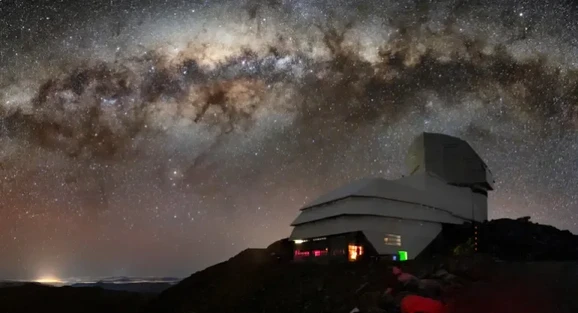
The team relied on the Dark Energy Camera mounted on the 4-meter Blanco Telescope in Chile to capture images of the night sky spanning eight billion light-years. These observations revealed tens of thousands of galaxy clusters—massive cosmic structures containing hundreds or thousands of galaxies bound together by gravity, resembling "knots of light in a vast cosmic web."
Galaxy clusters are not just spectacular sights; they serve as natural laboratories for cosmic physics. The gravitational pull within each cluster slows local cosmic expansion, allowing scientists to study how these massive structures grow over time and test whether the universe expands according to current theoretical models.
The new data were analyzed according to the Lambda-CDM model, the standard cosmological framework describing the universe as composed of:
-
70% dark energy, driving the accelerated expansion of the universe,
-
25% dark matter, holding galaxies together,
-
5% ordinary matter, including stars, planets, and everything visible.
Results show that the observed distribution of galaxy clusters closely matches predictions of the standard model, indicating that, despite its mysterious components, the universe behaves largely as expected within the limits of current observation.