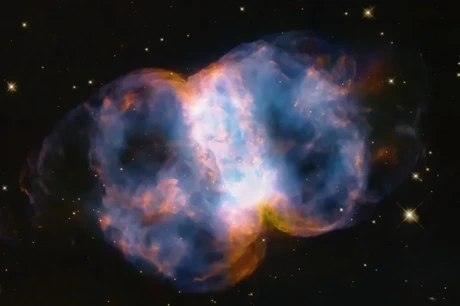


5 Planetary Nebulae That Captivate the Eye and Tell the Story of …
Not every cloud in the sky is a fleeting mist. Some are the final traces of stars much like our Sun, whose last moments …
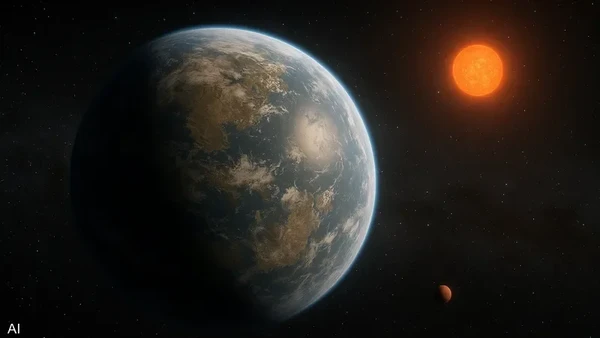
In a groundbreaking astronomical discovery that reignites humanity’s dream of finding life beyond our planet, scientists have identified a new Earth-like world — one of the most promising exoplanets yet for the search for extraterrestrial life.
According to a study published in The Astronomical Journal and reported by Science Alert, the planet, named GJ 251c, lies just 18 light-years away from Earth — relatively close in cosmic terms. Classified as a “super-Earth,” it has a minimum mass of about 3.84 times that of Earth.
Researchers explain that GJ 251c orbits within the habitable zone of its star — the perfect distance where liquid water could exist on its surface if a suitable atmosphere is present, making it a strong candidate for potential life.
Astrophysicist Suvrath Mahadevan from Pennsylvania State University noted that this ideal positioning makes GJ 251c a prime target for future exploration. Meanwhile, Paul Robertson from the University of California, Irvine, emphasized that the host star’s proximity — only 18 light-years away — provides a rare opportunity for detailed study.
The planet orbits a small, cool red dwarf known as GJ 251, which has roughly one-third the mass and diameter of our Sun. Because the star is dimmer and cooler, its habitable zone lies much closer in compared to that of our solar system.
Not every cloud in the sky is a fleeting mist. Some are the final traces of stars much like our Sun, whose last moments …
In a monumental astronomical achievement, an international team of scientists has compiled the largest catalog of galaxy clusters ever, using data from the Dark …
An international team of astronomers led by Ji-Bo Yu has solved a long-standing mystery about why thousands of supermassive black holes have slowed their …
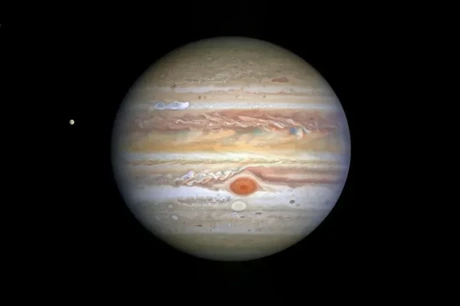
This week, the winter sky offers one of the most stunning astronomical sights of 2026, as Jupiter reaches opposition, appearing brighter and clearer throughout …
In a groundbreaking achievement, an international team of astronomers has announced the first direct evidence of a “baby planet” carving vast gaps in the …
While most people believe the universe will continue expanding forever, a team of scientists has proposed a bold new hypothesis that turns this idea …