

Al-Sharaa begins a tour that will take him to Brazil and the …
Syrian President Ahmad al-Sharaa has embarked on a historic international tour to Brazil and the United States — his first visit to South America …
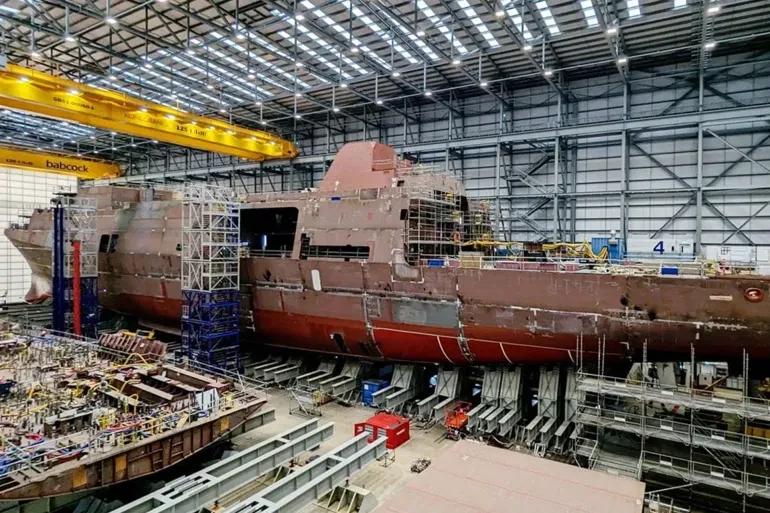
The American magazine The National Interest reported that the British Royal Navy is facing a new crisis after it was discovered that two Type 31 frigates were assembled incorrectly and outside the approved engineering sequence, leading to complex rework operations and additional delays that could cost up to $190 million.
According to the report, Babcock International acknowledged that the project has experienced higher-than-expected levels of rework due to design changes and long-term consequences caused by carrying out construction stages out of sequence since the beginning of the program.
The magazine described the incident as another setback to Britain’s efforts to rebuild the strength of its navy, which has lost much of its historical prestige compared to its status during the 19th and 20th centuries. It also noted that the Royal Navy now reportedly has more admirals than active warships.
The problems were said to be concentrated mainly in the first vessel of the new class, HMS Venturer, but the same issues also affected the second ship, HMS Active. The Royal Navy had intended these frigates to become the backbone of its future fleet.
“HMS Venturer” was originally expected to enter service in 2023 as part of a plan to operate five frigates by the early 2030s. However, the schedule faced repeated delays, pushing the expected service date to 2027 — a target that now also appears unlikely to be met. Current estimates suggest the ship may not begin operational missions until the end of the decade.
These developments come only weeks after the Royal Navy announced the retirement of the aging frigate HMS Iron Duke, despite the vessel previously undergoing a five-year modernization program that cost taxpayers more than $135 million.
Despite the ongoing difficulties, the magazine noted that the Type 31 frigates are, at least in theory, designed as multi-role warships capable of conducting surface warfare, air defense, land attack missions, and intelligence gathering. They were also planned to be equipped in the future with the Mk 41 Vertical Launching System, although this would require additional upgrades and maintenance work.
The report concluded that the Type 31 program, which was originally presented as part of a national strategy to revive British shipbuilding and restore the Royal Navy’s strength, has gradually turned into an increasingly expensive project plagued by repeated delays and growing technical problems.
Syrian President Ahmad al-Sharaa has embarked on a historic international tour to Brazil and the United States — his first visit to South America …
The crisis between Tehran on one side, and Washington and Tel Aviv on the other, escalated into a full-scale military confrontation this morning, in …
In Madagascar, the youth movement “Gen Z” has launched a new wave of protests and a general strike against President Andry Rajoelina’s government. Despite …
The visit of Saudi Crown Prince Mohammed bin Salman to Washington marks a major step in strengthening U.S.–Saudi relations. During his meeting with President …
Burkina Faso has announced a landmark decision to waive visa fees for all African nationals, aiming to boost continental unity, ease travel, and strengthen …
The Russian Ministry of Defense announced that its air defenses intercepted and destroyed 251 Ukrainian drones overnight — one of the largest such attacks …