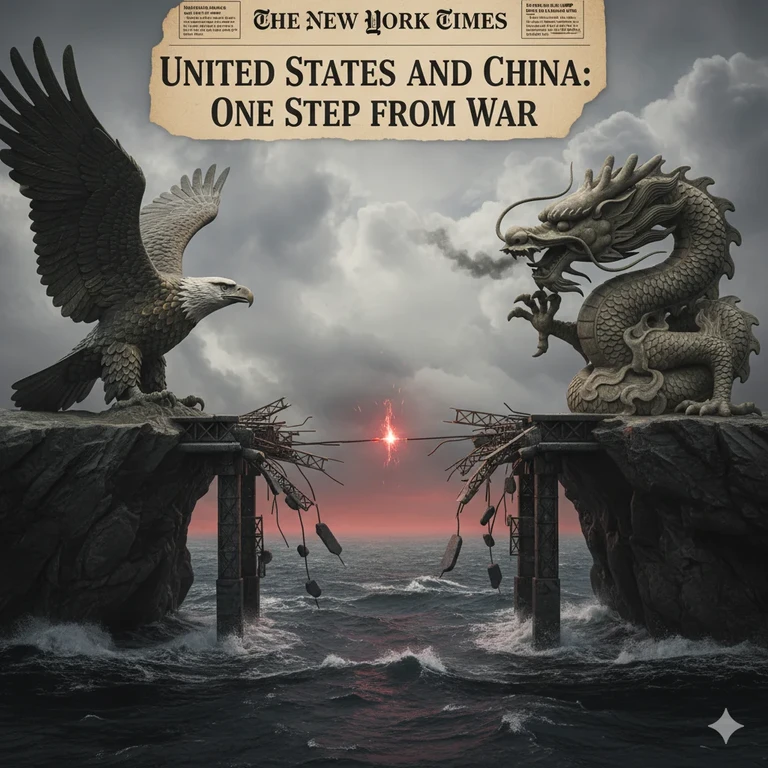
Writers Eric Rosenbach and Chris Li point out that relations between the United States and China are going through a highly sensitive stage, with the possibility of an unintentional military clash between the two powers now more realistic than ever.
In an article published in The New York Times, the authors explain that tensions are escalating in the South China Sea and the Taiwan Strait, with increasing incidents of aerial and maritime encounters between U.S. and Chinese forces in recent years — making even a small mistake capable of igniting a wider confrontation. For example, in May 2023, a Chinese fighter jet came dangerously close to a U.S. reconnaissance plane over the South China Sea, and in another incident, a U.S. aircraft was forced to change its course when a Chinese jet approached within just 20 feet. Beijing also released footage showing a confrontation between Chinese and American helicopters over the Taiwan Strait, while Australia reported that a Chinese fighter jet launched flares near one of its aircraft.
The writers warn that the real danger lies not only in these incidents but also in the lack of effective military communication channels between Washington and Beijing — unlike during the Cold War between the United States and the Soviet Union, when direct communication mechanisms and safety guarantees were established to prevent escalation into direct conflict.
The article notes that President Donald Trump, who is preparing to meet his Chinese counterpart Xi Jinping in South Korea, has made a trade deal with China one of his top priorities. However, the writers stress that trade cannot flourish without stability. Therefore, they call for establishing a permanent crisis management system between the two countries — a strategic move that could help secure peace and give Trump a historic legacy as the man who steered the world away from the brink of a new global war.
They cite history as a warning, recalling the Cuban Missile Crisis of 1962, when rising tensions between the U.S. and the Soviet Union nearly led to a nuclear confrontation. The authors also remind readers of a similar incident in 2001, when a U.S. surveillance plane collided with a Chinese fighter jet over the South China Sea, killing the Chinese pilot and leading to the detention of the American crew. They argue that resolving such a crisis diplomatically would be far more difficult today due to rising nationalism and military escalation on both sides.
The article further highlights that during the Cold War, Washington and Moscow exchanged pre-launch notifications and transparency measures that helped prevent disasters. In contrast, communication between Washington and Beijing remains limited and sporadic. The authors point to the 2015 Syrian experience, when reopening military communication channels between the U.S. and Russia helped prevent unintended clashes.
With China, however, military dialogue has been repeatedly suspended, most recently in 2022 following Nancy Pelosi’s visit to Taiwan. Although Joe Biden and Xi Jinping agreed in 2023 to resume contact, it has yet to evolve into a stable or effective system.
Last month, U.S. Defense Secretary Pete Hegseth held a call with his Chinese counterpart Dong Jun — a symbolic step toward improving relations — but the authors argue that occasional calls are not enough, especially since U.S. attempts to communicate are often met with silence from the Chinese side.
The article concludes by stressing that establishing a permanent military communication system between the two nations is now an urgent necessity — one that could very well be the difference between war and peace.