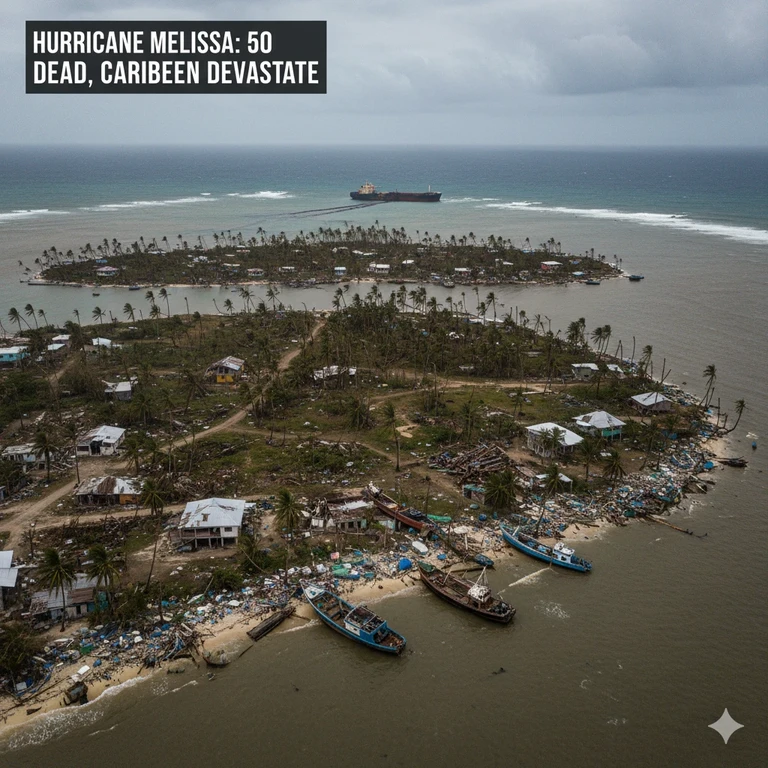
Hurricane Melissa, one of the most powerful storms ever recorded in the Caribbean, has begun to weaken after causing widespread destruction across Jamaica, isolating communities in Cuba, and flooding parts of Haiti, leaving at least 50 people dead.
According to meteorological centers, as of 11 a.m. (15:00 GMT) on Friday, Melissa had transitioned into a post-tropical cyclone with maximum sustained winds of 137 km/h, moving northeast toward Iceland and the Faroe Islands.
Experts noted that Melissa was the strongest hurricane ever to make direct landfall in Jamaica and the first major hurricane to do so since 1988. The U.S.-based weather company AccuWeather estimated economic losses across the western Caribbean at between $48 billion and $52 billion.
On Tuesday, Melissa struck southwestern Jamaica as a Category 5 hurricane, devastating areas that had already been hit by Hurricane Beryl the previous year. On Friday, Jamaica’s Minister of Information confirmed at least 19 deaths, warning that the number could rise, and noted that around 462,000 people remain without power, while emergency food distribution efforts are underway.
In Haiti, which was not directly hit by the hurricane but suffered days of heavy rain from the slow-moving storm, authorities reported at least 31 deaths and 20 missing persons. At least 23 people, including 10 children, died in the town of Petite-Goâve after a river overflowed its banks. Roads, homes, and farmland also sustained severe damage. The head of Haiti’s Transitional Presidential Council described it as a “sad moment for the country,” citing extensive destruction to homes, crops, and livestock.
Haitian authorities also warned of a possible resurgence of cholera, similar to the 2022 outbreak, as contaminated water spreads in the aftermath of flooding.
In Cuba, Melissa made landfall as a Category 3 hurricane, causing extensive damage to homes, roads, and crops, though no fatalities had been reported as of Friday. Hundreds of thousands of residents were evacuated from the eastern regions, particularly around Santiago de Cuba.
Brian Bogart, the World Food Programme’s Caribbean Director, described the situation in Black River, Jamaica, as “catastrophic,” saying, “It looks as if a bomb went off in this community. People are still in shock.”
According to AccuWeather, Melissa ranks as the third strongest hurricane ever recorded in the Caribbean and one of the slowest-moving, which intensified the damage. Scientists emphasize that rising ocean temperatures caused by greenhouse gas emissions are making hurricanes stronger and longer-lasting.
Caribbean island nations are frequently battered by hurricanes, and regional leaders have urged wealthy, high-polluting countries to provide financial aid or debt relief as compensation for the climate-related destruction driven by global warming.