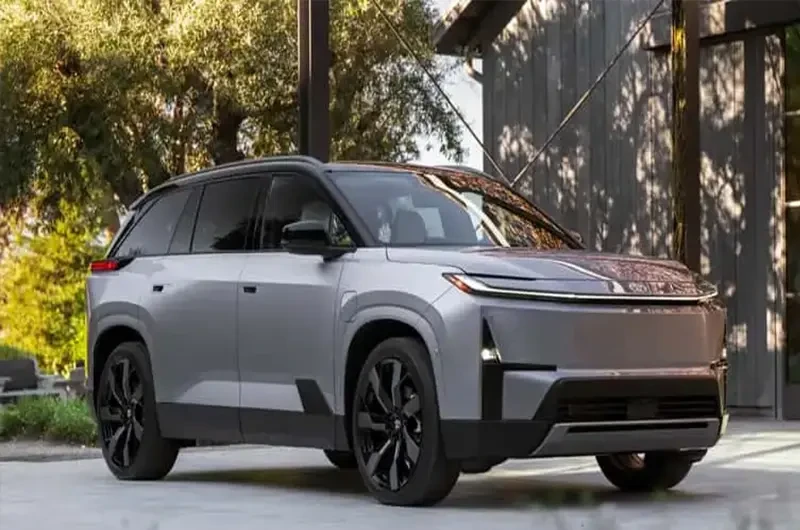
After a quarter-century of dominating the family crossover segment, Toyota is set to end the era of internal combustion for its iconic "Highlander." By 2027, the vehicle will transition into a fully electric powerhouse—a strategic move aimed at reclaiming market share and challenging giants like Tesla and BYD.
Strategic Repositioning to Combat Declining Sales
This radical shift comes in response to evolving consumer behavior. While Highlander sales peaked in 2021 with 264,000 units, 2025 saw a sharp decline to just 56,000 units in North America. This downturn prompted Toyota to completely redefine the model’s identity, positioning it as the spearhead of its upcoming electric fleet.
Technical Specs: Power and Range
The new electric Highlander is built on the enhanced TNGA-K platform, offering competitive performance options:
-
Drivetrains: Available in a Front-Wheel Drive version (~221 hp) and a Dual-Motor All-Wheel Drive version (~338 hp).
-
Battery & Range: Two battery options will be offered, with the larger 95.8 kWh pack providing an estimated range of up to 515 kilometers.
-
Charging Revolution: The vehicle will support the NACS standard (Tesla’s Supercharger network) and feature "Vehicle-to-Load" (V2L) technology, allowing the car to power external electronic devices.
A Smart Cabin: Luxury Meets Functionality
Toyota has not abandoned its user-friendly heritage, blending cutting-edge tech with tactile controls:
-
Displays: A massive 14.3-inch central touchscreen paired with a 12.3-inch digital instrument cluster.
-
Amenities: 64-color ambient lighting and dual wireless charging. Notably, Toyota has retained physical buttons for climate and audio controls to ensure driver safety and ease of use.
Market Arrival
The "Highlander EV" will be manufactured at Toyota’s Kentucky plant in the U.S. using locally produced batteries. It is expected to hit the markets in late 2026 or early 2027, joining the bZ4X and C-HR in Toyota’s accelerated journey toward full electrification.