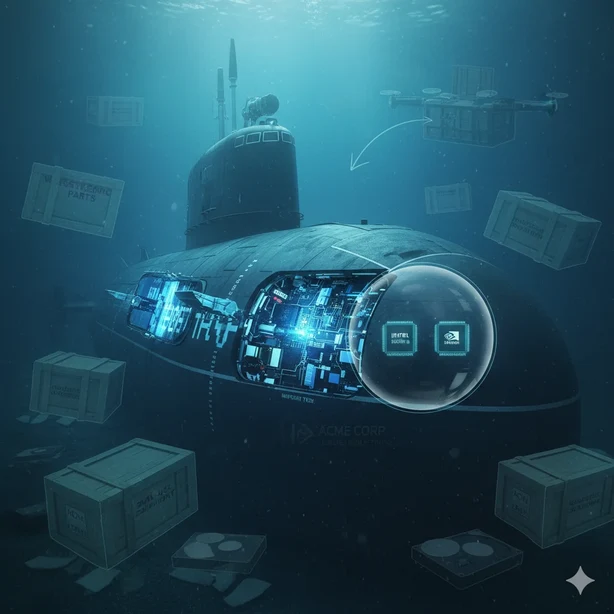
In a remarkable investigative report published by The Washington Post, journalist Greg Miller revealed that Russia had secretly obtained advanced Western technology to build an underwater surveillance network designed to protect its nuclear submarine fleet in the Arctic from detection.
According to the investigation—based on German court documents, financial records, and Western intelligence sources—Moscow developed a sophisticated surveillance system known as “Harmony”, using highly sensitive equipment acquired from American and European companies through a complex network of shell companies.
The Harmony network consists of underwater sensors, acoustic monitoring devices, advanced sonar systems, underwater drones, and fiber-optic cables that transmit data to surface analysis stations. Its main purpose is to detect U.S. submarines as they approach the bases of Russia’s fleet in the Barents Sea, enabling Russian submarines to enter and exit their Arctic bases undetected and complicating NATO’s tracking efforts during potential crises.
The investigation found that the operation was coordinated through Mostrilo Commercial Ltd., a Cyprus-based company later revealed to be a front for Russia’s military-industrial complex. Financial records show that the company spent tens of millions of dollars on advanced maritime equipment from Western firms, including the American companies EdgeTech and R2Sonic, as well as Norway’s Kongsberg.
During a trial in Germany, Russian citizen Alexander Shnyakin was convicted of violating export laws by purchasing sensitive technology on behalf of the Cypriot firm. According to Miller, German authorities acted after being alerted by the CIA in 2021, which led to raids, arrests, and U.S. sanctions against the company and its associated network. When journalists visited the firm’s Cyprus office last September, they found it abandoned and in disarray.
The Washington Post said the report was part of an international investigative project titled “Russia’s Secrets”, conducted in partnership with several European and Japanese media organizations. The investigation tracked Mostrilo’s transactions over a decade across NATO countries including the U.S., the U.K., Norway, Italy, and Sweden.
Many Western companies involved claimed they were unaware of the military applications of the equipment, having received assurances that it would be used for civilian or research purposes. However, experts argue that the failure of Western governments and firms to prevent Russia from acquiring such sensitive technology has undermined the security of the U.S. and its NATO allies.
Defense analysts warn that the Harmony system has significantly strengthened Russia’s strategic capabilities, allowing its nuclear submarines to depart and return to port without detection. The network reportedly stretches from Murmansk, in northwestern Russia, to the Franz Josef Land Archipelago, forming a defensive barrier that shields the Northern Fleet’s positions from Western surveillance.
The sensors also help Russian submarine commanders determine whether they are being tracked, allowing them to perform evasive maneuvers known in naval terms as “de-trailing.”
The report concludes that the project demonstrates how Moscow has exploited Western innovations to bolster its nuclear deterrent, while Western export control systems lagged behind. Built in complete secrecy using Western technology, the Harmony network now stands as a symbol of the growing challenge facing NATO amid the rise of a more technologically advanced Russian military presence in the Arctic depths.