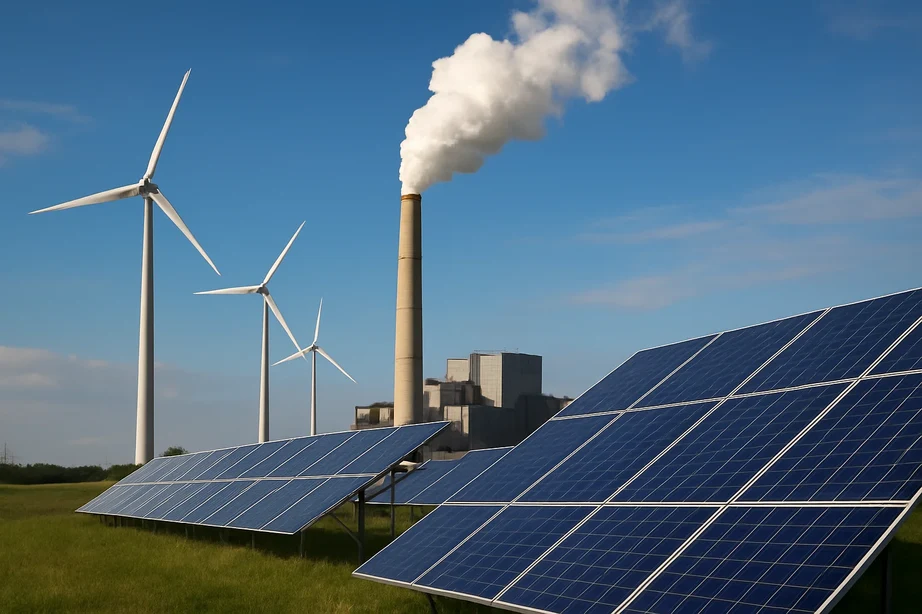
A recent study revealed that wind and solar power plants worldwide have, for the first time, generated more electricity than coal-fired stations — marking a major turning point in the global energy landscape.
According to the climate-focused research organization Ember, renewable energy managed to meet the global increase in electricity demand during the first half of 2025, leading to a slight decline in coal and gas use.
The report stated that global solar power generation rose by about one-third compared to the same period in 2024, covering roughly 83% of the growth in electricity demand. Wind energy also grew by over 7%, allowing renewable sources to gradually replace fossil fuels.
The study described this milestone as a “critical turning point”, marking the beginning of a phase where clean energy growth keeps pace with rising electricity demand.
It noted that China and India were largely responsible for this progress, while the United States and Europe continued to rely more heavily on fossil fuels. China, in particular, added more renewable capacity than the rest of the world combined, resulting in a 2% decline in its fossil fuel use compared to the first half of 2024.
Meanwhile, India increased its renewable energy consumption by more than three times the growth in electricity demand, leading to a 3.1% drop in coal use and a 34% decrease in gas use.
In contrast, the United States experienced electricity demand growth that outpaced its renewable expansion, resulting in a 17% rise in coal generation. In the European Union, electricity demand grew modestly, but weather-related slowdowns in wind and hydropower output caused increases of 14% in gas generation and 1.1% in coal generation.
A separate report by the International Energy Agency (IEA) projected that global renewable energy capacity could more than double by the end of the decade, with solar power accounting for about 80% of that growth.
IEA Executive Director Fatih Birol stated that solar photovoltaics would remain the main driver of renewable energy growth, supported by contributions from wind, hydro, bioenergy, and geothermal power. He added that expansion would not be limited to established markets but would also grow significantly in economies such as Saudi Arabia, Pakistan, and several Southeast Asian nations.
The agency also confirmed that China will continue to be the world’s largest growth market for renewable energy, with India emerging as the second largest throughout the remainder of the decade.
Today, China stands as the global leader in renewable energy production and use, accounting for 40% of total global capacity. The country has invested about $818 billion in green energy up to 2024 — more than the combined investments of the United States and the European Union — and plans to further expand its budget in this sector.
According to Ember Energy, China produced as much solar power in the first five months of 2025 as it did in all of 2020. Meanwhile, data from the World Economic Forum indicated that between January and May 2025, China installed enough new wind and solar capacity to generate as much electricity as Indonesia or Turkey produce in total.