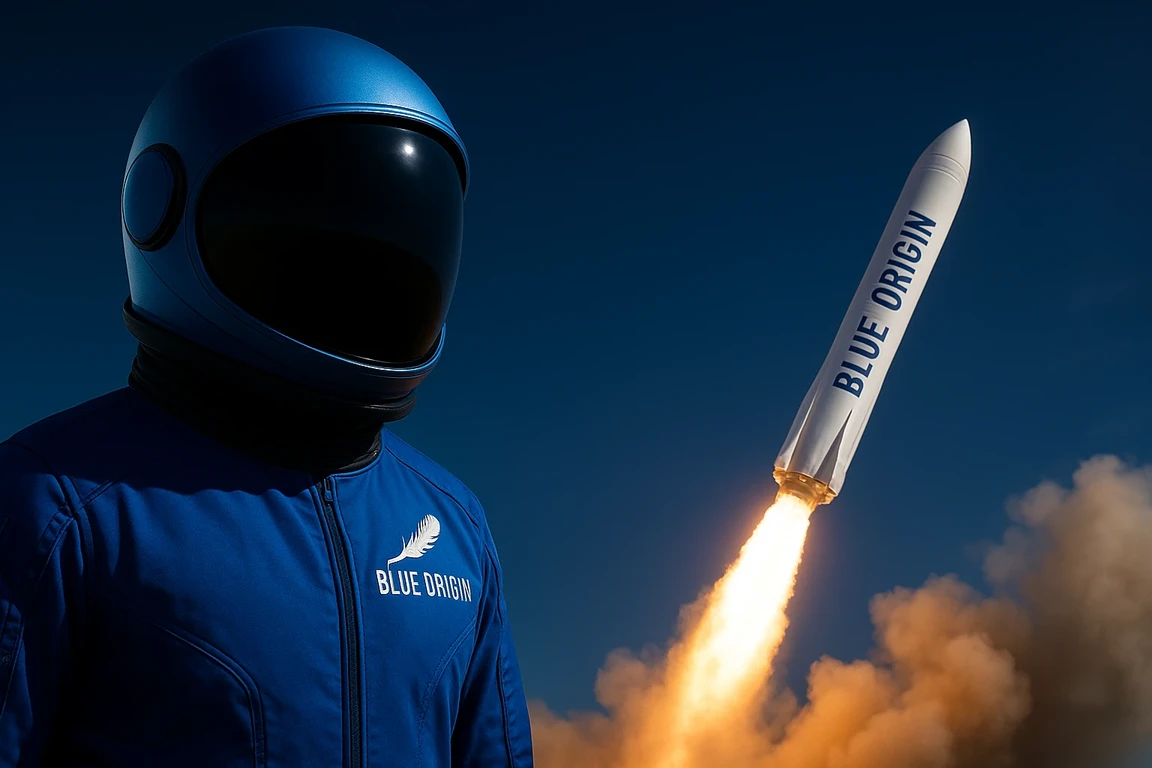
Blue Origin’s giant New Glenn rocket, built by Jeff Bezos’ space company, successfully launched from Florida on Thursday on its first mission for paying customers. The rocket carried two NASA satellites toward Mars and achieved its first successful landing of the reusable booster — a major milestone for the company.
It was New Glenn’s first flight since its debut in January. Both the launch and the booster’s landing at sea mark important steps as Blue Origin works to compete more directly with SpaceX, the current leader in commercial rocket launches.
A live webcast showed the rocket lifting off under clear skies after several delays caused by weather and a geomagnetic storm. About 10 minutes after liftoff, the 17-story first-stage booster touched down on the barge Jacklyn, named after Bezos’ mother. A similar landing attempt in January had failed.
This mission also marked the first time Blue Origin has delivered a science payload for NASA or any customer. NASA’s twin EscaPADE spacecraft were deployed roughly 20 minutes after launch to begin their 22-month journey to Mars.
CEO Dave Limp celebrated the achievement, and Elon Musk congratulated Bezos and the Blue Origin team on X.
The EscaPADE mission — Blue and Gold — will reach Mars in 2027. Once in orbit, they will study the planet’s space-weather environment for 11 months, focusing on how solar wind interacts with Mars’ weak magnetic field and contributes to atmospheric loss. The mission aims to help scientists understand how Mars transformed from a warmer world with water into the cold desert it is today.
Originally planned for October 2024, the mission was delayed due to New Glenn’s development setbacks. The satellites were built by Rocket Lab, with scientific instruments from UC Berkeley. The rocket also carried a small secondary payload from Viasat to test in-space telemetry relay — which Blue Origin says succeeded.
During its first-ever launch in January, New Glenn delivered Blue Origin’s own prototype spacecraft, Blue Ring, intended for defense and commercial clients.
Founded in 2000, Blue Origin has mainly been known for its New Shepard suborbital rocket, used for space tourism and research flights. But the company has invested billions into New Glenn, a heavy-lift reusable rocket meant to become its primary vehicle for crewed and cargo missions. Producing roughly twice the liftoff thrust of SpaceX’s Falcon 9, New Glenn rivals the Falcon Heavy in power and offers greater payload volume.
NASA has spent about $55 million on EscaPADE and paid Blue Origin $18 million for the New Glenn launch. The company also supplies rocket engines for ULA’s Vulcan Centaur and is developing a crewed moon lander for NASA’s Artemis program, as well as working on a future commercial space station.
Despite this progress, Blue Origin remains far behind SpaceX, which has flown nearly 280 Falcon missions in the last two years alone and continues developing the fully reusable Starship system for lunar, Martian, and large-scale satellite missions.