Latest1O1
Latest1O1
  • Home
  • Blog
5 Planetary Nebulae That Captivate the Eye and Tell the Story of Dying Stars
Hellokity |
8 Feb 2026

5 Planetary Nebulae That Captivate the Eye and Tell the Story of Dying Stars

Space
Join us on Telegram

Not every cloud in the sky is a fleeting mist. Some are the final traces of stars much like our Sun, whose last moments have transformed into breathtaking cosmic artworks. These phenomena are known as planetary nebulae, and they rank among the most beautiful and fascinating targets for astronomical observation.


Planetary nebulae… beauty born from an ending
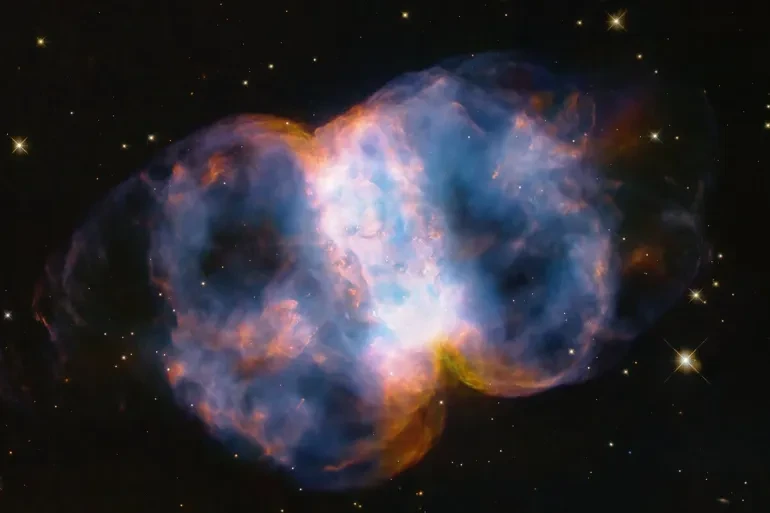
A planetary nebula is a shell of gas expelled by a star at the end of its life, after it has exhausted its nuclear fuel. At the heart of this scene lies an extremely hot white dwarf, emitting ultraviolet radiation that forces the surrounding gases to glow in stunning shades of green, blue, and violet. Despite their name, planetary nebulae have nothing to do with planets; they are visual testimonies to the inevitable fate of medium-sized stars.


For centuries, astronomers classified any fuzzy-looking celestial object as a nebula, until modern advances revealed the universe to be far more diverse and complex. Today, planetary nebulae are considered ideal targets for amateur astronomers, as they combine deep scientific significance with striking visual beauty—even under less-than-perfect skies.


From green beacons to drifting rings of smoke
Within this context, five of the most famous planetary nebulae stand out in the sky, each with its own unique character. From the Dumbbell Nebula (M27), known for its soft green glow and ease of observation, to the Ring Nebula (M57), which appears like a delicate smoke ring slowly fading into space. The Blue Snowball Nebula (NGC 7662) dazzles with its intense blue color, while the Blinking Nebula (NGC 6826) astonishes observers by appearing and disappearing due to a visual illusion. Completing the list is the Little Dumbbell Nebula (M76), a faint object that rewards patience with subtle and refined beauty.


These nebulae are more than just observation targets; they are windows into the distant future of our Sun. Each time we gaze upon them, we are not merely seeing a cloud of gas, but the final chapter of a star’s life—written in light across the vast stage of the universe.

#Galaxy #latest101 #space

Related Posts

A New World of Hope: “GJ 251c” Could Be Earth’s Closest Twin

A New World of Hope: “GJ 251c” Could Be Earth’s Closest Twin

Hellokity
2025 Oct 26

In a groundbreaking astronomical discovery that reignites humanity’s dream of finding life beyond our planet, scientists have identified a new Earth-like world — one …

💥 The End of the Universe in a Reverse Big Bang? Scientists Predict a Stunning Scenario Beyond Expansion

💥 The End of the Universe in a Reverse Big Bang? Scientists …

Hellokity
2025 Oct 11

While most people believe the universe will continue expanding forever, a team of scientists has proposed a bold new hypothesis that turns this idea …

🌌 Historic Discovery: Astronomers Spot the First "Infant Planet" Shaping Its Birthplace

🌌 Historic Discovery: Astronomers Spot the First "Infant Planet" Shaping Its Birthplace

Hellokity
2025 Sep 12

In a groundbreaking achievement, an international team of astronomers has announced the first direct evidence of a “baby planet” carving vast gaps in the …

🌕 Ancient Human Civilization on the Moon 50,000 Years Ago? NASA Faces New Claims

🌕 Ancient Human Civilization on the Moon 50,000 Years Ago? NASA Faces …

Hellokity
2025 Oct 07

For decades, the Moon has fascinated scientists — some see it as a silent rock orbiting Earth, while others believe it hides forgotten secrets …

Blue Origin Successfully Launches New Glenn for NASA

Blue Origin Successfully Launches New Glenn for NASA

Wookawooka
2025 Nov 14

Blue Origin successfully launched its New Glenn rocket on a NASA mission, delivering two satellites toward Mars and landing its reusable booster for the …

The Largest Galaxy Cluster Catalog in History Maps the Dark Universe

The Largest Galaxy Cluster Catalog in History Maps the Dark Universe

Hellokity
2025 Oct 29

In a monumental astronomical achievement, an international team of scientists has compiled the largest catalog of galaxy clusters ever, using data from the Dark …

We'd Love to Hear from You!

All rights reserved ©Latest1O1|Privacy & Policy
created by Libya Digital Wizard |