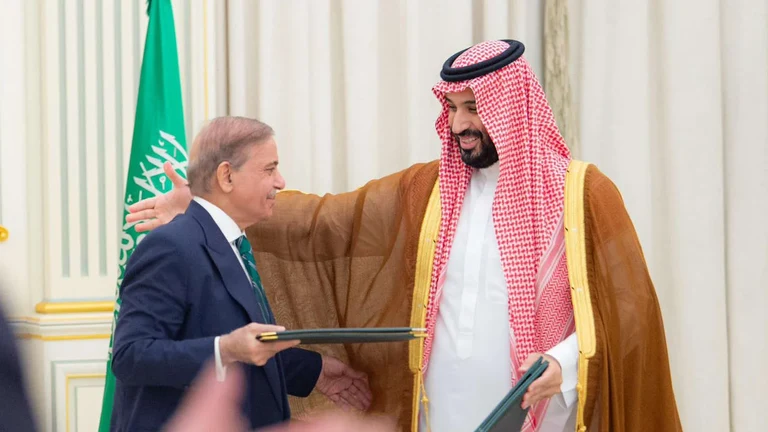
In a region fraught with tension, the signing of the Saudi-Pakistani joint defense agreement on September 17, 2025, in Riyadh marked a pivotal moment in the regional security landscape.
Following the Israeli strike on the Qatari capital, Doha, Gulf states accelerated efforts to redraw deterrence frameworks and alliances amid declining confidence in the traditional U.S. security umbrella. This report explores the driving forces behind the new alliance, its security implications, and geopolitical dimensions, raising the question of whether the Gulf is entering a phase of “multiple security umbrellas” that could redefine relations with Israel and reshape the Arab-Israeli conflict.
Beyond Bilateral Cooperation
The agreement cannot be viewed as a temporary bilateral arrangement but rather as part of a long-standing trajectory of Saudi-Pakistani ties. It intersects with nuclear deterrence calculations, power balances in South Asia, and China’s growing influence through its allies.
This reflects a mutual recognition of the need to expand strategic partnerships beyond traditional reliance on Washington, opening the door to cooperation in training, armament, and defense industries.
Deep Historical Ties
Since Pakistan’s independence in 1947, Saudi Arabia has stood by it politically and economically, with relations later evolving into a multifaceted partnership including financial, oil, and military support.
These ties strengthened further during the Soviet invasion of Afghanistan in 1979, when both countries played a central role in supporting the Afghan mujahideen, backed by Saudi funding and U.S. sponsorship.
Although relations faced tensions at certain junctures—such as the Yemen war, the Kashmir crisis, and the era of Imran Khan—they regained momentum under Prime Minister Shehbaz Sharif.
New Strategic Drivers
The Israeli strike on Doha marked a turning point, representing a direct breach of the security of a Gulf state and an influential regional mediator. This accelerated debates over Gulf security and collective deterrence options.
Against this backdrop, Saudi Arabia’s push to diversify its security partnerships beyond U.S. protection gained urgency.
Pakistan as a Strategic Partner
The choice of Pakistan was far from accidental. It rests on Islamabad’s military strength, regional experience, and undeclared nuclear deterrence capabilities.
The agreement stipulates that any attack on one party will be considered an attack on both, thereby cementing a long-term institutionalized defense partnership.
Security and Deterrence Implications
The pact delivers dual deterrent messages: to potential adversaries and to traditional allies. It signals a shift in Gulf defense doctrine—from fragmented national responses to a collective deterrence system based on binding commitments.
It also raises discussions over whether Saudi Arabia has effectively entered under an undeclared Pakistani nuclear umbrella, providing it with broader security options in an unstable region.
In this sense, the deal is more than a military arrangement; it is a reconfiguration of deterrence in the Middle East—combining Saudi Arabia’s economic and military weight with Pakistan’s nuclear capabilities—sending a clear message that Gulf security is no longer dependent on a single guarantor
In the backdrop of the Saudi-Pakistani alliance, China emerges as an unofficial yet influential player through its growing military and technological support for Islamabad.
According to defense reports cited by Reuters, global militaries have closely monitored the performance of Chinese J-10 fighter jets and PL-15 missile systems operated by Pakistan, describing them as a decisive factor in aerial engagements.
U.S. officials, quoted by Reuters from Islamabad and Washington, confirmed that Pakistan used these Chinese jets to shoot down Indian aircraft—demonstrating the effectiveness of the jet-missile integration as a powerful deterrent tool.
This synergy between Chinese technology and Pakistani expertise not only strengthens Pakistan’s deterrence capabilities but also enhances its standing in regional power balances, making it an even more attractive partner for Saudi Arabia amid rising threats.