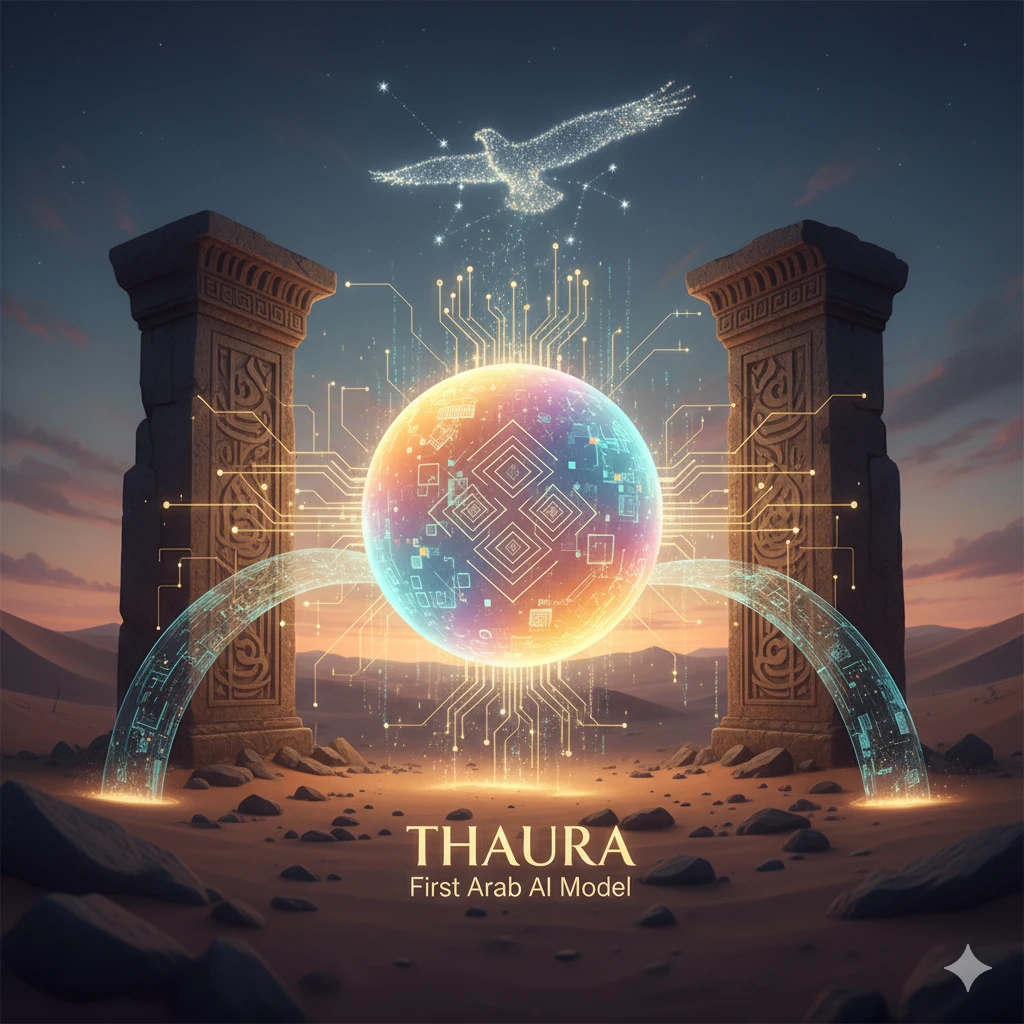
In a world dominated by major Western tech corporations, the new Arab AI model “Thawra” emerges as a bold attempt to answer a long-standing question: Where do Arabs stand in the age of artificial intelligence?
What makes “Thawra” stand out is not only that it is primarily an Arabic AI model, but also that it operates using a fundamentally different approach from the mainstream models built by global tech giants, according to a report by Tech for Palestine.
The model was created by two Syrian brothers, Hani and Saeed Al-Shihabi, who left Syria before 2011. After settling in Germany and working for years in major tech companies, they eventually decided to pursue their own path by developing an Arab AI model focused on user privacy, factual information, and environmental efficiency.
A fundamentally different technology
At first glance, “Thawra” may appear to be simply an attempt to “Arabize” existing AI technologies. Yet in reality, it is built on a completely different technical foundation. The model is powered by GLM-4.5 Air, an open-source “mixture-of-experts” system that includes over 100 billion parameters.
Instead of activating all parameters at once for every prompt, “Thawra” uses only 12 billion per query.
This approach significantly reduces energy consumption compared to models that utilize their full computing power every time, making Thawra — according to its official website — 93% more efficient than ChatGPT.
The developers note that this structure gives the model greater speed and accuracy for everyday tasks, while also lowering operational costs. It is also fully compatible with OpenAI’s API ecosystem, making it suitable for various coding and development applications.
Privacy first
“Thawra” runs on secure servers provided by DigitalOcean backend and TogetherAI inference — platforms that operate independently from major tech companies or governments. According to Tech for Palestine, all conversations with Thawra remain encrypted and fully protected, with no selling or external analysis of user data.
Although the system retains some chats, this is done solely for technical optimization.
An Arab identity with a clear mission
Speaking to Inside Baraka, Hani Al-Shihabi explained that he and his brother entered the tech field seeking to create long-term impact. One of their main motivations was the lack of an AI model grounded in ethical responsibility and user privacy, especially in light of what they describe as Western media opacity surrounding Arab issues, including Palestine.
Hani notes that alternatives exist in other fields — such as DuckDuckGo for search, Signal for messaging, and Brave for browsing — but not in AI. He adds that many people, including one of his aunts, rely heavily on AI tools daily, which he finds concerning because some models “lack an ethical framework,” something he describes as “frightening.”
The brothers emphasize that “Thawra” is designed for users seeking an AI that respects privacy, upholds a moral conscience, supports marginalized communities, and stands firmly with Arab causes — foremost among them the Palestinian cause.