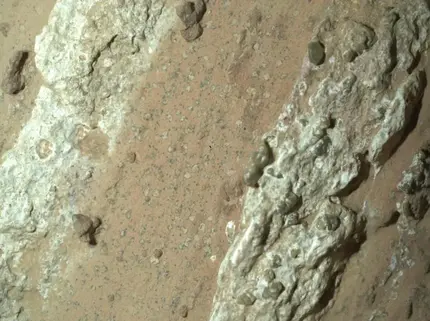
A rock sample gathered by NASA’s Perseverance rover on Mars may hold traces of ancient microbial life, preserved for billions of years on the Red Planet.
This possible “biosignature” is not direct proof of life itself, but rather a clue suggesting that certain textures seen in the rock could have biological origins.
“This discovery from our amazing Perseverance rover is the closest we’ve ever been to finding evidence of ancient life on Mars,” said Nicky Fox, associate administrator of NASA’s Science Mission Directorate, during a Wednesday press briefing.
The idea that Mars once supported life has long been debated among scientists and remains a central focus for NASA’s broader mission to understand the origins of life and whether humans are alone in the universe.
The rock, named Cheyava Falls, was collected in July 2024 from an ancient dried-up riverbed in Jezero Crater — a 28-mile-wide basin located just north of the Martian equator.
Sedimentary rocks from the site were found to contain clay, silt, organic carbon, sulfur, oxidized iron (rust), and phosphorus.
Researchers were especially intrigued because the rock displayed dark, spot-like markings that resembled leopard spots.
“These textures tell us that something unusual happened here. Some chemical processes were at work when these rocks were deposited,” explained Joel Hurowitz, a planetary scientist at Stony Brook University and lead author of a new study published in Nature.
Hurowitz suggested the spots might be mineral patterns left behind by ancient microbes that once used organic carbon, phosphorus, and other compounds on the rock as an energy source.
“When we see similar features in sediments on Earth, they are often linked to microbial activity consuming organic material and producing minerals as byproducts,” he said.
Carbon and phosphorus are both vital elements for molecules essential to life, such as DNA.
Although the study has been peer-reviewed, NASA officials emphasized that more research is needed to confirm or rule out the biosignature.
In the past, claims of Martian life have been met with skepticism. For example, a Martian meteorite discovered in Antarctica in 1984 was once thought to hold microbial fossils. Later studies showed the material had geological — not biological — origins.
Currently, further analysis of the Cheyava Falls sample is limited, since Perseverance’s instruments can only do so much remotely. The rover, however, was designed to collect rock samples that could eventually be brought back to Earth for closer examination.
That plan may now be at risk. President Donald Trump’s budget proposal, released in May, called for a 25% cut to NASA’s budget — more than $6 billion — and included canceling the Mars Sample Return program, a joint project with the European Space Agency to bring Perseverance’s samples back home.
At the briefing, NASA’s acting administrator, Sean Duffy, said the agency is reassessing mission plans and timelines.
“We believe there’s a faster and cheaper way to return these samples,” Duffy said. “That’s the review we’re undertaking right now.”
Launched in 2020, Perseverance has spent over three years exploring Jezero Crater before climbing to its western rim.