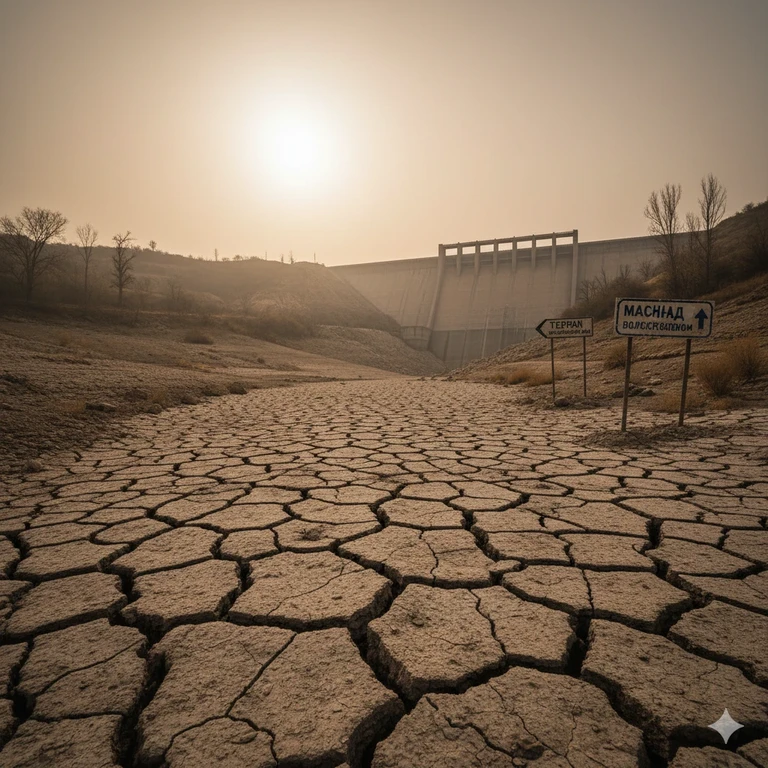
An Iranian official confirmed that water levels in the dams supplying the northeastern city of Mashhad have dropped to less than 3%, as the country faces severe drought and a critical water shortage. The situation has become so serious that President Massoud Pezeshkian warned that the capital, Tehran, could face possible evacuation if rainfall continues to decline.
Hossein Esmaeiliyan, the CEO of the Mashhad Water Company, told the Iranian Students' News Agency (ISNA) that the four dams feeding Mashhad—Torgh, Kardeh, Doosti, and Ardek—have reached critical levels, with three of them no longer operational except for the Doosti Dam. Mashhad, home to around 4 million people, consumes about 700,000 cubic meters of water daily, with consumption reaching 8,000 liters per second.
Unprecedented drought
In Tehran, authorities warned of potential ongoing water cuts as the country experiences its worst drought in decades. The government announced temporary water shutdowns during evening hours to allow reservoirs to refill, with the Minister of Energy stressing that such measures have become unavoidable.
The Iranian president also cautioned that without rainfall before winter, even Tehran may face evacuation risks. Five major dams supplying drinking water to the capital have reached “critical” levels, with one completely empty and another operating at less than 8% of capacity.
Officials further revealed that 19 major dams across the country have completely dried up, while some have seen a dramatic 92% drop in rainfall compared to last year.
A structural crisis
Iran is enduring a deepening water crisis caused by drought, climate change, and poor resource management. The country has witnessed rising temperatures, shrinking water sources, and a sharp decline in rainfall. Since September, Iran has recorded just over 2 millimeters of rainfall—75% less than the same period last year—while 21 provinces have received no rain at all.
Iran is also facing the world’s worst land subsidence, driven by drought, climate change, and excessive groundwater extraction. More than 90% of the country’s water supply goes to agriculture, and thousands of illegal wells further deplete groundwater reserves.
The president’s remarks about evacuating Tehran sparked widespread criticism, with the city’s former mayor calling the idea “illogical.” Local newspapers blamed the crisis on mismanagement and the appointment of unqualified officials, arguing that “politics is being prioritized over climate” in water-related decision-making.