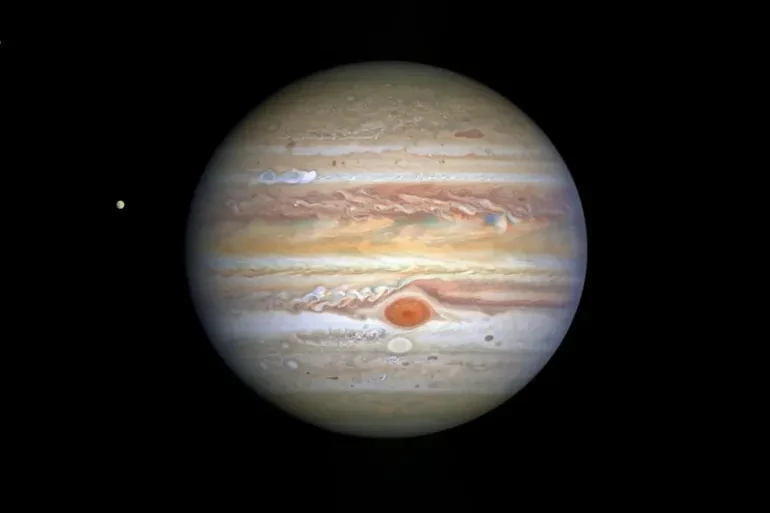
Astronomy enthusiasts are witnessing a remarkable celestial event these days as Jupiter reaches opposition, marking the best opportunity in 2026 to observe the largest planet in the solar system and study its features with the naked eye or through telescopes.
Astronomer Ibrahim Khadr, a board member of the Jordanian Astronomical Society, explained that during opposition Jupiter is at its closest distance to Earth, making it shine more brightly in the night sky—especially as it appears among the prominent stars of the winter season.
He noted that opposition occurs when Earth lies directly between the Sun and Jupiter, causing the planet to rise at sunset and remain visible until sunrise. At this time, Jupiter appears larger and more luminous than at any other point during the year. Jupiter reached opposition at dawn on January 10, 2026, after approaching Earth to a distance of about 634 million kilometers during the early hours of the previous night.
Khadr added that Jupiter is currently located in the constellation Gemini, near its two bright stars, and is now the brightest object in the night sky after the Moon. It can be easily spotted as a steady, bright white point in the eastern sky after sunset. Using binoculars, observers can see Jupiter’s four large moons—Io, Europa, Ganymede, and Callisto—aligned around it as small points of light, while telescopes reveal its distinctive cloud bands and more detailed features of its turbulent atmosphere.
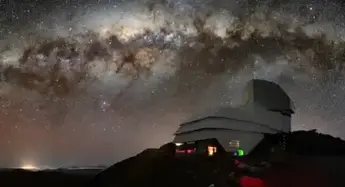
Jupiter’s opposition is a major occasion for astronomers and astronomy societies in the Arab world and beyond, with group observation events and astrophotography workshops being organized to mark the phenomenon. Its position among the stars of the Winter Hexagon adds exceptional beauty to the scene.
Although the day of opposition marks the peak of the event, Jupiter will remain an ideal target for observation for weeks—and even months—to come, as it stays relatively high in the evening sky.
Khadr concluded that Jupiter’s opposition is not merely a fleeting astronomical event, but a rare opportunity that combines visual beauty, ease of observation, and scientific value, while also inspiring reflection on the vastness of the universe and the precision of the solar system.