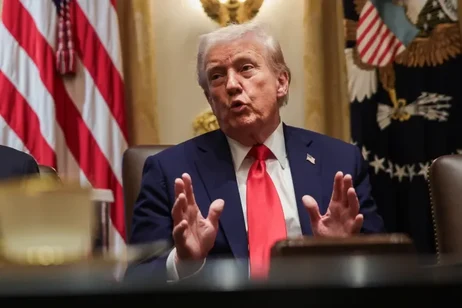
The U.S. markets experienced a turbulent end to the week after President Donald Trump announced the imposition of an additional 100% tariff on Chinese imports starting November 1, 2025, marking a new escalation in the ongoing trade war between the world’s two largest economies, according to a report by Investing.com.
Market turmoil after the announcement
The decision triggered a sharp sell-off in U.S. stocks as investors rushed to gold as a safe haven, while oil prices suffered a significant decline.
In a statement posted on Truth Social, Trump accused China of adopting “an extremely aggressive stance in trade” and sending “a hostile message to the world” through its plans to impose broad export restrictions, describing the move as “an unprecedented event in international trade history and a moral disgrace in dealing with other nations.”
Trump confirmed that the new tariffs would be added to the existing ones and would coincide with U.S. restrictions on the export of sensitive software, noting that implementation could be accelerated if China takes further retaliatory actions.
Sharp decline in U.S. stocks
Even before the official announcement, Trump’s remarks sparked heavy selling in the markets. The Dow Jones Industrial Average fell by 1.9%, the S&P 500 dropped 2.7%, and the tech-heavy Nasdaq plunged 3.6%.
According to Investing.com, losses continued in after-hours trading as investors awaited a possible Chinese response that could deepen global market instability.
Gold shines amid uncertainty
Meanwhile, gold prices surged to record highs as investors sought safety. Gold futures closed at $4,030.30 per ounce, up 1.45%, while spot gold rose 0.9% to $4,012.90.
Analysts said gold benefited from the “rapid shift in risk appetite” following the U.S. escalation, along with a 0.45% drop in the U.S. Dollar Index to 98.95 points, which supported demand for safe-haven assets.
Oil prices collapse
In contrast, oil prices plummeted amid growing concerns over global economic slowdown triggered by the new tariffs. West Texas Intermediate (WTI) crude fell 4.32% to $58.85 per barrel, while Brent crude declined 3.85% to $62.71.
According to Investing.com, markets are now “pricing in a potential drop in global energy demand” as trade tensions rise and confidence in industrial growth weakens.
A new escalation in the trade war
Observers described Trump’s latest move as the strongest escalation since the start of the trade war, coming in response to China’s announcement of new export restrictions on rare earth metals and sensitive technological products.
Experts told Investing.com that this escalation could bring markets back to the 2018–2019 atmosphere, when reciprocal tariffs caused severe disruptions in global supply chains and trade.
A shift in global investment sentiment
The stark contrast between rising gold and falling oil and stock prices reflects, according to analysts, a major shift in investor sentiment, as capital flows toward defensive assets amid increasing uncertainty over the future of U.S.–China economic relations.
The report concludes that the coming days will be a test of the markets’ resilience in absorbing the tariff shock, especially as China is expected to respond with retaliatory measures targeting major U.S. corporations and bilateral trade.