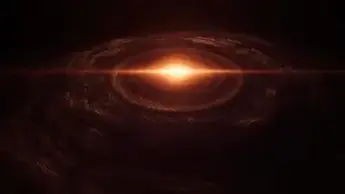
In a groundbreaking achievement, an international team of astronomers has announced the first direct evidence of a “baby planet” carving vast gaps in the dusty disk surrounding a newborn star. The discovery, named WISPIT-2b, marks a turning point in our understanding of how planets form—an enduring scientific debate for decades.
Why Is This Important?
For years, scientists have suspected that the gaps seen in protoplanetary disks are created by emerging planets. Until now, however, no one had provided conclusive proof. With WISPIT-2b, astronomers finally have direct confirmation that infant planets can sculpt these gaps.
Inside the New System
-
Host star: TYC-5709-354-1 (or WISPIT-2), a young, Sun-like star
-
Distance from Earth: 434 light-years
-
The infant planet: WISPIT-2b, a gas giant about five times the mass of Jupiter
-
Location: Orbiting at 54 astronomical units (AU), inside a massive cavity of gas and dust
How Was It Detected?
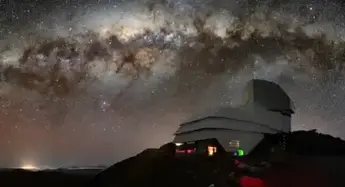
Researchers used a cutting-edge instrument called MagAO-X, mounted on the Magellan Telescope in Chile, to capture the unique H-alpha emission produced as hydrogen gas falls onto the forming planet. These observations were combined with data from the Very Large Telescope (VLT) at the European Southern Observatory for confirmation.
A Glimpse Into the Past
This rare finding offers a window into what our own Solar System may have looked like in its earliest days, when the young Sun was still surrounded by dusty disks that eventually gave birth to planets and asteroids.
The results were published in two papers in The Astrophysical Journal Letters, opening the door to a new era of planetary formation research.