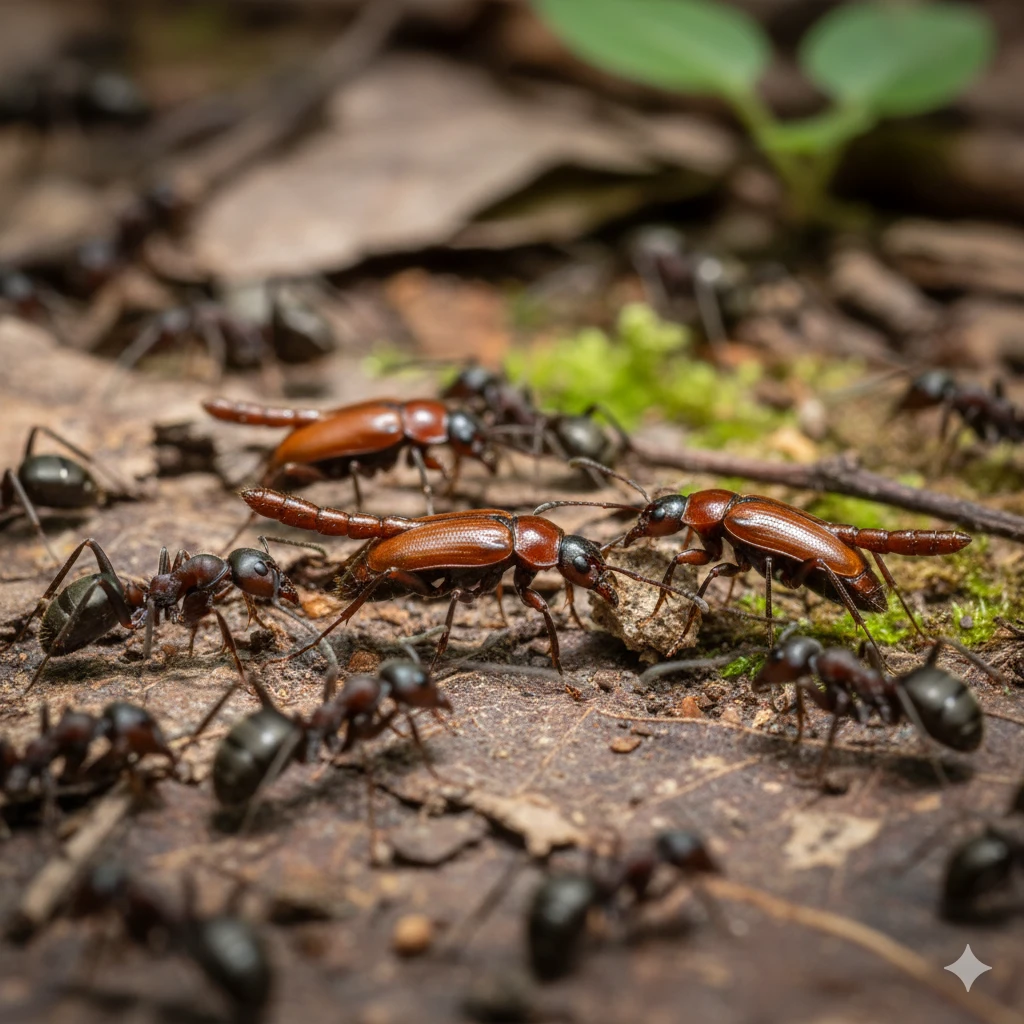
Ant colonies are among the most organized and well-protected environments in the insect world. These social insects have a strong ability to detect intruders quickly through their sense of smell and will attack them to protect their young inside the nest. Despite these strict defenses, some insects have found clever ways to enter ant colonies without being detected.
One example is a group of beetles known as rove beetles, which belong to the family Staphylinoidea. These are small beetles commonly found on forest floors in many parts of the world. Scientists have observed that some of these beetles are able to live inside ant colonies by using sophisticated forms of camouflage.
One species, Septobius lativentris, lives in Angeles National Forest near the California Institute of Technology (Caltech). A research team led by biologist and biological engineer Joe Parker began studying the relationship between these beetles and ants in 2017 to understand how these insects manage to live inside ant colonies without being discovered.
In a study published in the journal Cell, researchers explained that this beetle uses a special strategy that makes ants treat it as if it were one of their own, even though it benefits from living inside the nest.
The ants’ chemical recognition system
One of the most important defense mechanisms ants use is their chemical recognition system. When two ants from the same colony meet, they touch each other with their antennae to check a specific scent pattern that identifies members of the colony. This process works through chemical compounds known as cuticular hydrocarbons, which are waxy substances covering the bodies of insects.
These compounds serve several purposes. They help reduce water loss from the insect’s body and also function as signals that allow insects to recognize members of their colony and distinguish them from outsiders. Each ant colony has its own chemical signature, so worker ants inspect any creature they encounter. If its scent does not match the colony’s scent, it is treated as an intruder and attacked.
The beetle’s camouflage strategy
Research has shown that Septobius beetles use a clever strategy to avoid detection. At a certain stage of their life, they have almost no scent of their own. They then obtain the colony’s scent directly from the ants themselves.
The beetles climb onto worker ants and clean their bodies using their legs. During this process they collect the chemical compounds from the ants and transfer them onto their own bodies. As a result, the beetles acquire a scent similar to that of the colony, causing the ants to treat them like members of their own group rather than attacking them.
With this chemical disguise, the beetles can live inside the nest without being discovered. In some cases, ants may even feed them in the same way they feed other colony members. Meanwhile, the beetles benefit from living in the nest by feeding on some of the ants’ eggs and larvae.
Dependence on the colony
This relationship shows how some organisms rely on others for survival. These beetles need to remain close to ants in order to obtain the chemical compounds that allow them to blend into the colony.
Experiments have shown that the compounds the beetles collect from ants can disappear from their bodies in less than 20 hours, which means they must regularly renew them by interacting with the ants.
Scientific observations
Researchers also conducted laboratory experiments to see whether these beetles could interact with other types of ants. They found that the beetles sometimes attempt to approach different ant species and clean them to obtain their chemical compounds when the opportunity arises.
Studies also suggest that the beetles only need to detect the presence of a nearby ant to collect the chemicals they need.
In the end, this phenomenon highlights the complexity and organization found in the insect world, and shows how even very small creatures can use precise strategies to live within highly protected environments such as ant colonies.